
Wazuh Cloud Aims to Reduce Security Operations Complexity for Hybrid Environments
Wazuh Cloud is a managed SIEM/XDR platform designed to reduce security operations complexity by handling infrastructure, scaling, updates, and data processing while helping teams monitor endpoints, detect threats, assess vulnerabilities, support compliance, and reduce alert fatigue with AI-assisted analysis.
Security operations teams are facing growing pressure as enterprise environments become more distributed, cloud-based, and difficult to monitor. Organizations now commonly manage a mix of on-premises infrastructure, public cloud platforms, containers, Kubernetes clusters, remote endpoints, and third-party services, while also maintaining compliance with frameworks such as PCI DSS, HIPAA, GDPR, NIST 800-53, and CIS Benchmarks.
At the same time, threat activity continues to increase. Ransomware groups, advanced persistent threats, supply chain attacks, credential theft, and cloud misconfigurations have made security monitoring more complex. Many security operations centers now process thousands of alerts per day, often with high false-positive rates.
This creates a major operational problem. Analysts spend significant time reviewing noisy alerts, tuning detections, maintaining infrastructure, and managing platform performance instead of focusing on higher-value work such as threat hunting, incident response, and risk reduction. The result is slower mean time to detect, slower mean time to respond, and a higher chance that real threats are missed.
Managed SIEM and XDR platforms are increasingly being positioned as a way to reduce this burden. Wazuh Cloud, the managed cloud-based version of the open-source Wazuh platform, is one example of this shift.
The Challenge with Traditional Security Operations
Running a self-managed SIEM or XDR platform can give organizations flexibility, but it also introduces operational overhead. Security teams are often responsible for provisioning infrastructure, configuring ingestion pipelines, tuning rules, managing storage, patching systems, scaling clusters, and maintaining performance.
Deployment can also take weeks or months, especially in environments with mixed operating systems, cloud workloads, containers, and remote endpoints. During that onboarding period, visibility gaps can remain across critical assets.
Alert volume is another major issue. SIEM platforms may collect millions of events and generate thousands of alerts, but without strong correlation, enrichment, and prioritization, analysts are forced to manually determine which events matter. This contributes to alert fatigue and makes it harder to quickly identify real incidents.
Scaling can also become difficult as endpoint counts grow or as organizations add cloud-native workloads. Indexing, storage, retention, and query performance may require additional infrastructure planning or architecture changes. For smaller teams, that infrastructure work can compete directly with security investigation work.
How Wazuh Cloud Approaches the Problem
Wazuh Cloud is designed to shift much of the infrastructure and maintenance burden away from internal security teams. Instead of requiring organizations to deploy and manage their own Wazuh backend, the managed service handles backend operations, scaling, updates, and platform availability.
The platform uses lightweight Wazuh agents across Windows, Linux, macOS, cloud workloads, containers, and other supported systems. These agents collect security telemetry, monitor file integrity, assess system configuration, detect vulnerabilities, and forward events to the managed Wazuh Cloud environment over encrypted channels.
Wazuh Cloud includes several security modules commonly used in enterprise monitoring, including File Integrity Monitoring, vulnerability detection, Security Configuration Assessment, log analysis, threat detection rules, and compliance mapping. These features allow teams to monitor endpoint activity, configuration drift, unauthorized file changes, software weaknesses, and policy violations from a centralized interface.
Managed Architecture and Data Processing
Wazuh Cloud uses a managed distributed architecture that includes the Wazuh server, indexer, and dashboard components. The backend handles event ingestion, indexing, storage retention, and query performance without requiring customers to manage the underlying infrastructure.
Events collected by agents are normalized and processed through Wazuh decoders and rules. These rules are mapped by category, severity, and MITRE ATT&CK techniques, helping analysts understand how specific alerts relate to known attacker behaviors.
The managed indexer layer is intended to reduce the performance issues that often appear in self-hosted environments, especially as data volume increases. Automatic scaling helps support growth in agent count and event ingestion without requiring security teams to manually resize clusters or redesign infrastructure.
AI-Assisted Security Analysis
Wazuh Cloud also includes Wazuh AI Security Analyst, an AI-assisted analysis layer designed to help security teams interpret alerts, vulnerability data, and endpoint activity.
Rather than replacing analysts, the feature is intended to reduce manual triage by summarizing important security activity, highlighting trends, identifying high-risk findings, and generating recommended remediation priorities. Weekly AI-generated assessments can help teams better understand recurring issues, exposed systems, and areas where risk is increasing.
This type of AI-assisted workflow reflects a broader industry trend. Security vendors are increasingly adding AI and automation to help reduce alert fatigue, speed up investigation workflows, and provide more context around complex events.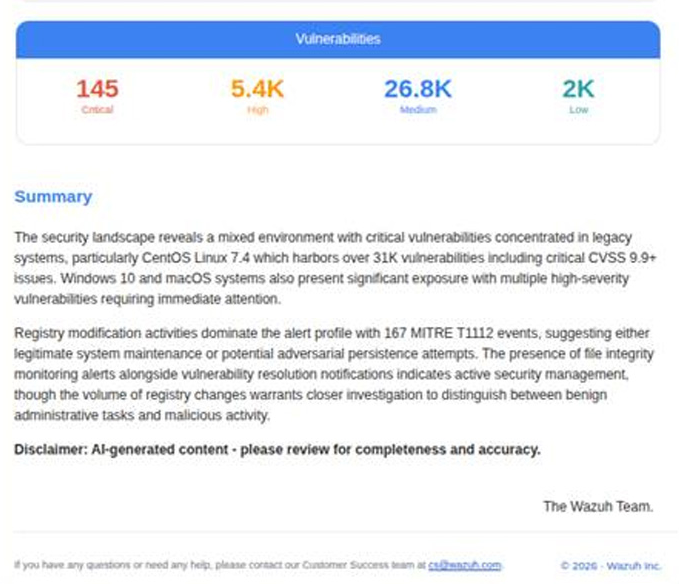
Operational Impact for Security Teams
The main value of a managed platform such as Wazuh Cloud is operational simplification. By reducing the need to maintain backend infrastructure, security teams can spend less time on patching, scaling, tuning, and storage management.
For small and mid-sized teams, this can be especially important. Many organizations do not have dedicated SIEM engineers, and analysts may be responsible for both platform maintenance and incident response. Removing infrastructure management from that workload can improve response times and reduce analyst fatigue.
For larger organizations, the benefit is often consistency and scalability. A managed platform can help standardize monitoring across hybrid environments while reducing the need to maintain separate infrastructure for each region, business unit, or workload type.
Why It Matters
Security operations complexity has become a major challenge for organizations of all sizes. The issue is no longer just whether a company can collect security data. The larger challenge is whether teams can deploy quickly, process alerts efficiently, scale as infrastructure changes, and respond to threats before damage occurs.
Wazuh Cloud addresses those challenges by offering a managed version of the Wazuh platform that handles infrastructure operations while retaining core SIEM and XDR capabilities. Its focus on endpoint monitoring, vulnerability detection, compliance assessment, file integrity monitoring, and AI-assisted analysis makes it relevant for organizations trying to improve visibility without adding more operational burden.
As hybrid and cloud-native environments continue to expand, managed security platforms are likely to become more common. For many teams, the key question is whether maintaining a self-hosted SIEM still makes sense when infrastructure management, scaling, and alert triage consume resources that could otherwise be used for threat detection and response.

Comments
0 public comments
No comments yet
Be the first to add a comment to this article.
Add a comment
Please sign in to comment on this article.
Sign In